The happiness delusion
The Social Mind #4

It has never been easier to find out how to be happy. Talk of happiness – defined by one popular dictionary as ‘enjoying or characterised by well-being or contentment’ – saturates social media platforms, organisational cultures and policy discussions. Its achievement is seen as both moral good and personal responsibility, and we’re encouraged to want it so incessantly that experiencing normal frustrations and disappointments can feel like failure.

Few of us live the kind of unremittingly joyful existence implied by Instagram grids. The inevitable sense of missing the mark hints at a paradox at the heart of happiness: caring about it too much can prevent us from experiencing it. Is chasing happiness making us unhappy?
Professor Irene Mauss has investigated the pursuit of happiness and its discontents. In 2011, she and some colleagues published a paper on the ‘paradoxical effects’ of valuing happiness. These researchers had asked people questions about how much they valued happiness while measuring various aspects of their well-being: for example, how content participants were, how depressed they felt, and the balance of their positive and negative feelings.
The researchers found that those who valued happiness the most and worked hardest to become happy were worse off on every measure of well-being, possibly because these individuals criticise themselves more for experiencing negative feelings or to get more frustrated by them. Mauss and her team concluded:
‘These findings are consistent with the idea that valuing happiness leads to less happiness by setting people up for disappointment.’
More recent research suggests that the problem is not necessarily wanting to be happy, but how much weight we give it. A variety of data collected over 11 years led Mauss and colleagues to suggest that aspiring to happiness isn’t a problem – good news, given how difficult it would be not to want to be happy. The issue comes in the level of concern. When we’re concerned about happiness, we tend to judge it. This judgement can lead events that might otherwise be experienced positively to have a tinge of negativity about them which, in turn, undermines happiness.
Treating happiness lightly is a difficult sell. There are almost 200 million posts on Instagram using the happiness hashtag. Positive psychology is having a moment, particularly online and in classrooms. Teaching resources include lesson plans that get children to create collages of happy moments and plant flowers that spell ‘happy’ when they bloom. It may be harder for children to develop emotional range and resilience, though, when they are so focused on achieving one feeling.
For the rest of us, it’s hard to ignore the cultural hyper-focus on happiness when it’s broadcast through social media channels, workplaces and lecture halls, and it’s harder still to argue against it when doing so appears so counterintuitive: who wouldn’t want to be happy?
The happiness hype links too, I think, into a wider phenomenon in which we are encouraged to feel good in the moment – to avoid challenging relationships, experiences and emotions in the pursuit of immediate comfort.
The problem is that we need grit for growth – and growth, in the end, is what supports us to find meaning and purpose in what we do. To use a basic analogy, you can’t get strong without breaking some muscle fibres along the way. The same process that causes discomfort during a weights session and temporary soreness after it means you can lift more next time.
There is also a massive research literature demonstrating that exposure to discomfort is what helps us to manage it in future, and that avoidance erodes resilience. The way to overcome social anxiety is not to avoid friendships and social gatherings; it is, gently but insistently, to socialise.
Rather than getting caught up in the web of inducements by influencers and well-meaning authority figures to be happy, evidence suggests that focusing elsewhere may work better for longer-term happiness and well-being. The Harvard Study of Adult Development, which has been tracking American adults for decades, finds that close relationships are the most important predictor of both happiness and longevity.
Happiness research surfaces some contradictory findings. Parents come off worse than non-parents when it comes to the balance of positive and negative emotions, for example, but they report more meaning and purpose. Contradictions may relate to differences in meaning: some researchers understand happiness as short-term pleasure and avoidance of pain (the ancient Greek concept of hedonic well-being); as opposed to longer-term fulfilment that’s achieved through both meaning and purpose (eudaemonic well-being). Others group these elements together as a single construct. But no-one has yet come up with anything better, leading researchers of a paper published in the Annual Review of Psychology to comment:
‘The idea that there are a good [eudaenomic] and a less good [hedonic] type of happiness fits with a psychological conceptualization of classic philosophical notions of the good life. However, this conceptualization is challenged by the science of meaning in life, as research suggests that it does not capture the many good lives that appear to exist nor the ways that well-being is experienced by people in their everyday lives.’
The research is imperfect. But we probably know enough to suggest that chasing happiness leads it to slide from our grasp. It makes me think of insomniacs pursuing sleep. That desperate sense of needing rest drives it further away.
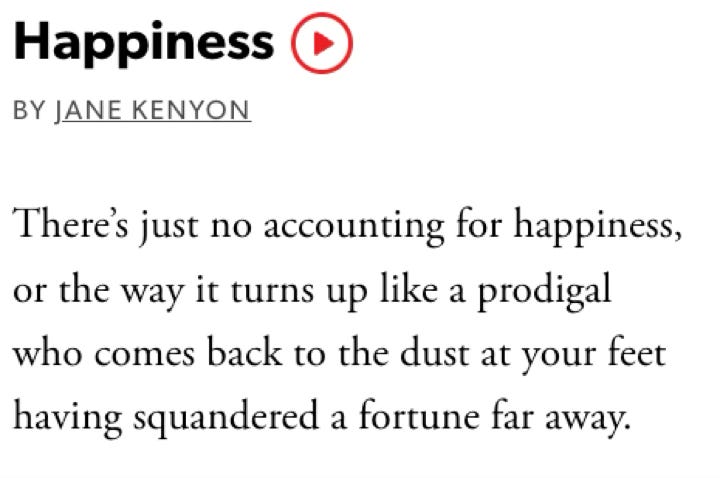
Care about happiness, by all means – but never too much, and as a byproduct rather than a goal: ignore the Instagrammers. A more useful ambition might be to find meaning, purpose and excellent friends.
Evidence-Based Parenting is available here and Teenagers: The Evidence Base can be found here.
Information about my next book will be available on this Substack later in 2026.