

Mortals versus the machine
Which forms of social connection really matter?

I didn’t think I’d start this article by demonstrating why humans are like dogs, yet this is where I find myself. Experimental research demonstrates that our body odour is more similar to that of our friends than it is to random strangers, and that similar-smelling strangers are more likely to get on with each other than pairs who have divergent whiffs. This is the equivalent, I think, of dogs taking a lungful of other hounds’ hindquarters to work them out. ‘We could predict bonding with an electronic nose,’ wrote the researchers of their human subjects. ‘We conclude that there is indeed chemistry in social chemistry.’

Online connections have, in many cases, supplemented or even replaced real-world ones. People see AI ‘therapists’ and coaches, scroll their friends’ lives through the lopsided lens of social media, and attend online school or college. We’re at such an early stage of research into these areas that it’s hard to draw conclusions, but early signals suggest that social chemistry happens in the real world, not the virtual one. This piece isn’t an argument against virtual connections: there are benefits to these (and downsides, of course). WhatsApp, video calls and social media help to fill gaps between in-person meet-ups. They’re no replacement for walking with friends, eating together, or shared nights at gigs or football matches or the pub.
A peculiar magic happens when we talk to someone else in person (assuming no arguments or simmering resentments), do a task together or pay joint attention to a TV programme, lecture or game. Research shows that the brain activity of people in these situations starts to align with each other. So do signals from the autonomic nervous system, which governs unconscious tasks such as digestion and breathing. Sitting in a room with a friend, partner or colleague can make your heart rates and breathing align, as well as how intensely you experience your emotions.
Computers are incredible, but they can’t do that.
Psychologists refer to this phenomenon of brain-body alignment as ‘co-regulation’. It’s a key feature of parent-child relationships: according to a review in the journal Children, co-regulation ‘is a cornerstone of children’s biological, socioemotional, and cognitive well-being and adaptation throughout the balance of the life course’.
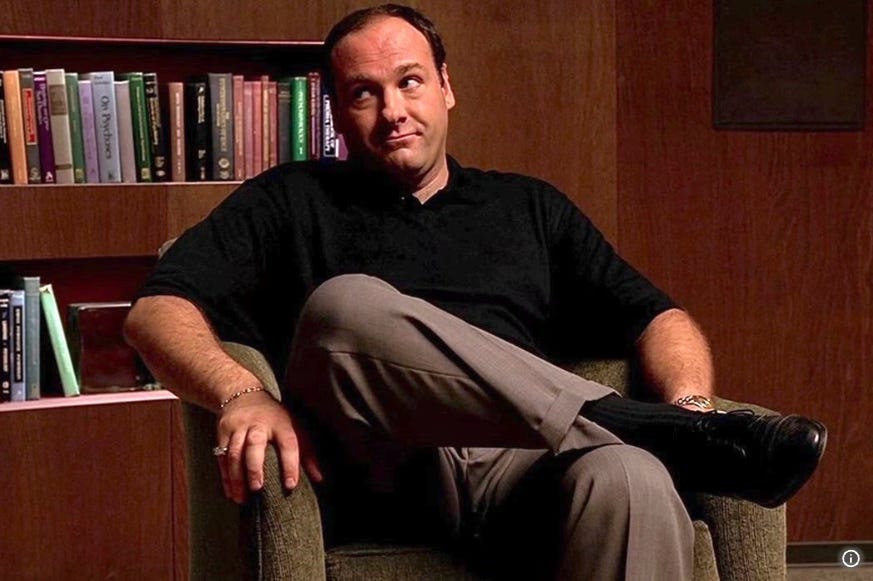
It’s also a core feature of psychotherapy. In theory, a therapist uses his or her own emotional regulation to support clients’ ability to regulate themselves (viz Tony Soprano’s therapist helping to stabilise him after he experiences panic attacks). In practice, co-regulation is more complex and dynamic than simply mirroring or stabilising emotions – research shows, for example, that therapists tend to respond to high levels of client arousal by becoming neutral and calm. When a mafioso recalls moments of turbulence, this calmness might help his physical stress response to resolve itself more quickly and provide him with a template to do this for himself in future.
Couples co-regulate. So do friends. While dogs almost certainly experience emotions in a different way to humans, there’s evidence of physiological alignment between species: in dog competitions, for examples, dogs have been shown to mirror levels of the stress hormone cortisol found in their human handlers. (This article is about humans: I don’t mean to keep coming back to canines. It is also useful, though, to compare how we synchronise with each other to other parts of the natural and human-influenced world. Some species of fireflies can synchronise their flash patterns with each other. Metronomes placed next to each other on the right surface will eventually come into sync.)

According to authors of a review paper about the human version of this phenomenon, context matters: people’s heart rates are more similar to each other when they’re exposed to new ideas or experiences in certain settings, while social anxiety gets in the way – the self-focus and hypervigilance of people who feel anxious around others make it harder for them to attune. The authors write:
‘These moderating effects highlight that physiological alignment is not a passive by-product of co-presence or coordinated movement but a dynamic marker of social openness, trust, and mutual regulation.’
In other words, we don’t passively pick up other people’s states of mind and body. We are social beings, and we create them together.
Why does this matter when it comes to in-person versus virtual connections? Once we reach adolescence, the role of parents (the pioneers of our ability to co-regulate) diminishes and friends take a more prominent role. Smiling and other in-person social signals can support a sense of safety and belonging. Social connection is linked to a host of benefits: less stress, more resilience, better well-being and even longer life. One meta-analysis finds that people are 50% more likely to survive over a given period when they have strong social relationships.
The problem is that there’s not enough research to know definitively whether the second part of my paragraph above (the benefits of social connection) definitively relate to seeing other people in the real world. Contradicting my ‘computers can’t do it’ point made earlier, researchers recently published a paper entitled ‘Emotional Coregulation in Close Relationships with AI Agents’. They concluded that ‘emotions’ (scare quotes are mine) can transfer from AI agents to humans, and that these agents can support emotional co-regulation. There are huge issues with this study. It was a one-off survey of just 48 people; and it was based entirely on self-report, with none of the brain scans, heart rate measures or skin conductance tests that can demonstrate the transfer of emotions alongside less conscious physical signals of alignment between individuals.
Most importantly, the entire premise of the research question was wonky. It’s possible that interaction with a machine can change people’s emotions, but the idea of emotional contagion or co-regulation is a non-starter. Emotions are part of being alive, expressed by and felt in the body as well as the mind: the release of hormones and neurotransmitters, for example, link both to our thoughts and how we feel physically. They cannot be caught from or mirrored by artificial intelligence.
While machines can’t support emotional contagion or co-regulation, we can’t be sure that some kinds of virtual interactions don’t mimic the positive effects of these. We can make some well-educated guesses, though. If you think back to the pandemic, you were probably online more than at any previous point in your life, whether that was in the form of Zoom team meetings, virtual drinks and quizzes, or catch-up calls with family and friends (‘Any news? No. Me neither. And loo-roll hoarders are still stripping the supermarket shelves.’) And yet the pandemic’s real-life social isolation has been linked to many negative outcomes, including poor mental health and substance abuse.

In our modern, hyperconnected environments, there’s a risk of becoming a newfangled Luddite – criticising technology from the edges while failing to make use of its many brilliant features. I don’t suggest we abandon the forms of connection that technology enables, nor do I think it is now possible to do this even if we wanted to.
I do believe, though, that we need to be cautious. Social chemistry is real and important, just as it is to dogs licking lampposts to understand (via the urinary bush telegraph) who has visited and what they were signalling. There’s plenty of evidence that social chemistry happens in person, while there are question marks about its virtual facsimiles.
Hallmarks of modern life, including working from home, virtual workshops and mobile-focused sofa nights, need careful balancing with the real world.
Evidence-Based Parenting is available here and Teenagers: The Evidence Base can be found here.
Information about my next book will be available on this Substack later in 2026.
I think that we are feel this instinctively . After a chat with a friend on line or even on the phone we end up by saying’ we must meet up very soon for a proper catch up’. Nothing replaces a touch on the arm during a conversation