Looking-glass selves
Personality, other people and the insatiable desire for self-knowledge

If you’ve applied to or worked for a large employer, you may well have been asked to take a personality test. The most recognisable of these types of test is the Myers-Briggs Type Indicator, which slices groups up into sixteen types of individual. Some of its offshoots create enticing pen portraits – the website 16Personalities, for instance, offers up ‘bold, imaginative and strong-willed leaders’, ‘smart and curious thinkers’ and ‘enthusiastic, creative and sociable free spirits’.
To return to the Barnum effect, humans have a tendency to see nuance and distinctiveness in broad, sweeping descriptions. You can probably see yourself in each of those three categories above, if you try hard enough. I’m going to make the case in this piece that personality tests have universal and enduring appeal, that they’re part of our thirst for self-knowledge through other people – the ‘looking-glass self’ – and that understanding ourselves through actual human relationships is probably a healthier approach.
One problem with these personality tests is that they’re blunt tools. I’m an introvert if I score 49.5% on a sliding introversion-extraversion scale; an extrovert if I score a single percentage point more. Some of the findings aren’t that consistent. You may well change Myers-Briggs profiles if you retake the test on another day in a different mood.
There’s better evidence for the ‘Big Five’ personality tests, which measure people’s openness, conscientiousness, extraversion, agreeableness and neuroticism. A recent systematic review found that conscientious, extraverted, agreeable employees who are open to new experiences perform well in the workplace, whereas poor old neurotics do not. Its authors wrote:
‘The study’s conclusions imply that companies ought to use personality tests in their hiring, team-building, and performance-management plans.’
Imagine, for a moment, a workplace in which everyone is the same – where everyone is competing loudly to get their point across at the water cooler, and where there are no anxious, detail-oriented people ready to spot the flaws in the extroverts’ grand plans. (Susan Cain’s book Quiet is useful on the value of introverts.) You might well get better task performance from ebullient, agreeable people if you’re looking narrowly at single roles, but organisations tend to suffer from sameness. It’s risky to assume that what works at a micro level is effective at a macro level too.
Beyond employment screeners, companies also use personality tests to build teams and improve performance. The problem with this – a recurring theme in my Substacks – is a dearth of evidence. A rapid evidence assessment on personality-feedback interventions in the workplace found that beneficial effects are unsubstantiated and that negative side effects are possible. Its authors urged practitioners to apply these interventions with caution.
Colour profiles are another way to place people into neat and tidy boxes at work – you might be a decisive, competitive red, an analytical blue, a reflective green or a social, creative yellow. (This is reductive – the categories are more complex than this, but you get the broad idea.) I did a colour profile workshop once and remember being surprised by the ‘accuracy’ of my results. My profile knew I was independent and liked challenges, and even intimated at my particular, peculiar spreadsheet habits. I didn’t consider that there were only four colours – that the broad brushstrokes of my profile could be painted just as specifically, or vaguely, onto one in four of the working population. More recently, my partner of 25 years did a similar workshop at which he was told his profile was completely incompatible with mine. (We’re still together.)
Companies persist with these kinds of tests in part because they are thought to provide a type of magical sorting hat into which employees’ personalities can be aligned with future projects and promotions. A 2018 piece in the New Yorker pointed out that American white-collar jobs rapidly overtook farm jobs in the early 1900s, and said: ‘You do not need a test to figure out who should milk the cow, but you might want to have a method of distinguishing your salespeople from your managers.’
Another reason for the enduring popularity of workplace personality testing is its appeal to employees. We look to other people to understand ourselves, including how we are similar to and different from each other, and we’ve done so for millennia. In ancient Greece, the four humours – yellow bile, black bile, phlegm and blood – were thought to determine human characters. The gloomy melancholics had too much black bile; the phlegmatics were calm; the cholerics were hot-tempered; and the sanguines, full of hot blood, cheerful and extroverted, shared much with the ideal Big Five-type employee.
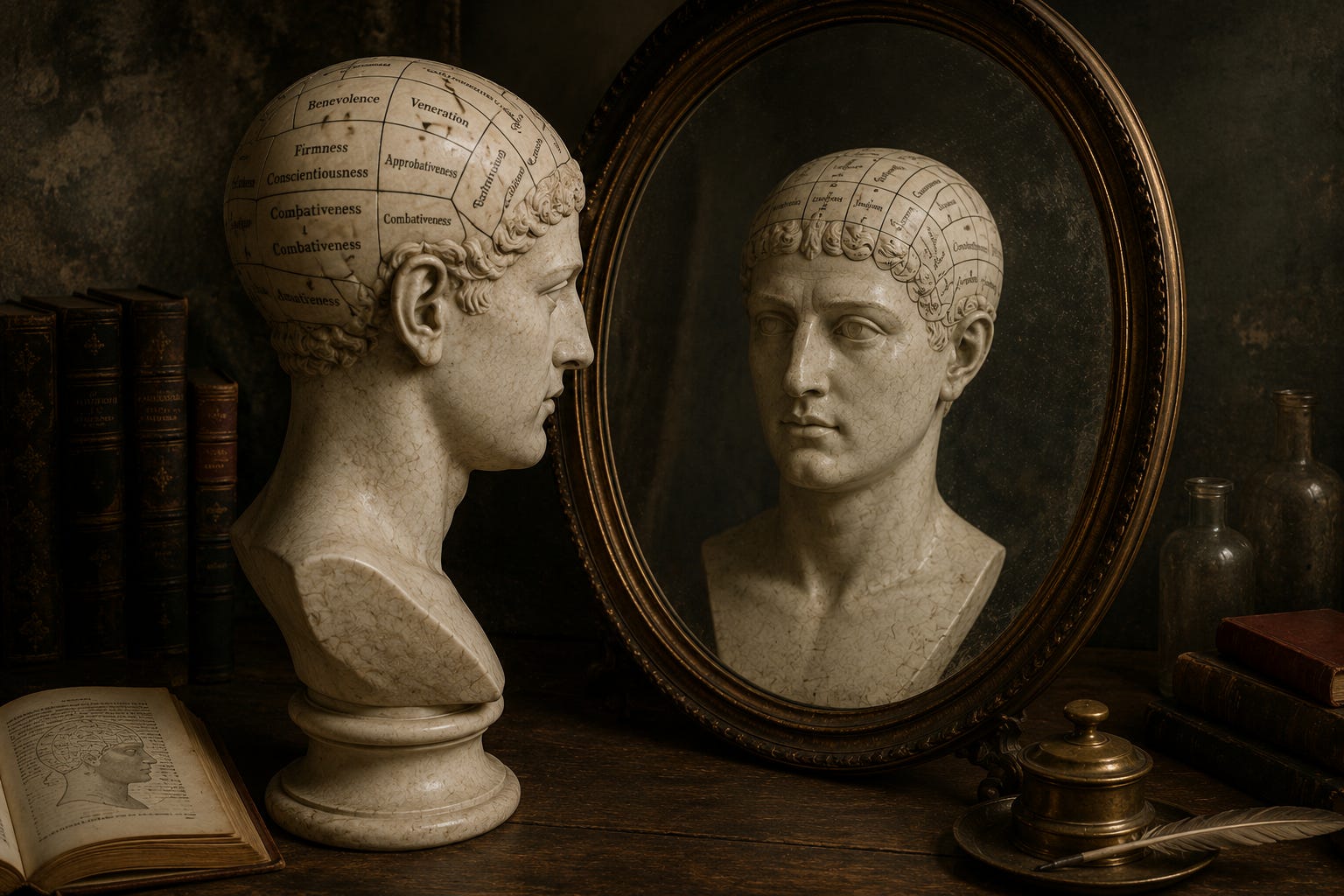
Fads have come and gone in the centuries since. Humans have tried to understand themselves through various pseudoscientific iterations including phrenology (skull shape), graphology (handwriting, which – if shared scrawlings were really a marker of character and aptitude – might have suggested medicine as an alternative career for me) and horoscopes.
The sociologist Charles Horton Cooley coined the term ‘looking-glass self’ in 1902 to describe the idea that we build our identities based how we perceive other people to view us. We effectively look into a social mirror to build self-knowledge. According to Cooley:
‘As we see our face, figure, and dress in the glass, and are interested in them because they are ours, and pleased or otherwise with them according as they do or do not answer to what we should like them to be; so in imagination we perceive in another’s mind some thought of our appearance, manners, aims, deeds, character, friends, and so on, and are variously affected by it.’
Our inner worlds don’t make sense unless they’re seen in relation to other people’s. But we can never know for certain what those other worlds contain. We have to rely on proxies – and what better than an easy tick-box assessment that divides us and links us, and offers seemingly deep assessments of how we fit within our social worlds?
The peak of personality assessments probably hasn’t yet been reached. One review warns (for me, rather chillingly) of AI’s potential in assessing personality for employers:
‘For example, personality can be inferred from interactions with AI chatbots, and machine learning algorithms can be trained to infer personality traits form asynchronous job interviews that predict interview performance better than self-rated personality traits.’
Perhaps AI can succeed where humans have failed. Yet this seems a frustratingly deterministic stance – people can shift even in areas commonly believed to remain relatively consistent over the lifetime. The same review cites research showing that people get significantly more conscientious after taking on their first job, for example.
I also wonder about the long-term effects of believing other people’s judgements about our personalities, particularly given research in other areas (such as mental health and illness) showing that labels may make symptoms more permanent. If I’m told I’m neurotic, do I become neurotic about my neuroticism? Does it remove the possibility of ever finding even-temperedness?
Our looking-glass selves rely on other people for their self-image. Perhaps it’s the sense of permanence inferred by personality tests that’s the real risk. Mirror images vary depending on the light of the room, whether the subject has slept well, his or her age, and a host of other factors. Similarly, our sense of selves shift across time and audiences.
This impermanence is, I think, a good thing. Of course, there are some aspects of ourselves that are pretty unyielding to social contexts or the weathering of time, but keeping a sense of possibility open – in areas in which it’s feasible to do so – means that negative ways of relating to other people can be changed. There’s also power in knowing that we’re not entirely the subjects of our genes, upbringings and other people’s whims.
The looking glass is vital. Knowing that we won’t always see the same reflection is important, too.
This Substack is usually out once a fortnight, but the next edition will be 14 August.
Evidence-Based Parenting is available here and Teenagers: The Evidence Base can be found here.
Information about my next book will be available on this Substack soon.