

Life On Mars #1
Autonomy, junk food and school commutes

Welcome to my Substack summarising the latest research on teenage mental health and well-being. It’s called Life On Mars partly because the distance between teenagers and their parents or teachers often seems vast, even if their planets circle closer to each other than we might think. Reason two: Bowie was a genius (although he got teenagers wrong. In Changes, he wrote that children are immune to their parents’ consultations. The research says otherwise.) The title is also a nod to Jonathan Haidt’s recent book, The Anxious Generation, in which he uses the analogy of Mars to discuss links between smartphones and teenage mental health.

I’m not convinced by Haidt’s thesis that there’s a strong, causal link between smartphone use and plummeting levels of adolescent well-being (that’s a topic for a future Substack). But I’m drawn to the idea that teenagers may lose their earthly anchor-points if we don’t get a better handle on what the research is telling us. Some of this is counterintuitive – for example, talking more to teenagers about mental health (in an attempt to help them and to destigmatise anxiety, depression and similar conditions) may be making some of them feel worse.
This Substack will look into the issue of mental health awareness and more, focusing on newly published research as it comes out. I won’t cover everything: almost 4,000 journal articles about teenagers have been published in 2024 so far that have one of ‘mental health’, ‘anxiety’, ‘depression’ or ‘well-being’ in the title, according to Google Scholar. My life is no infinite monkey cage. But I’ll pick out a few that look interesting each time, along with some thoughts and possible implications.
Life On Mars is free to subscribers for the foreseeable future: sharp-eyed readers will notice that I have two books to sell.
‘Psychological freedom’ is probably good for teenagers (and younger children), unlike feeling stifled or internally conflicted
Study title: Relationships Between Experiences of Autonomy and Well(Ill)-Being for K-12 Youth: A Meta-Analysis (October 2024)

My last interaction with the subject of physics was pre-GCSE, and so the concept of engine oil is a simple one to my mind – you pour it into a car and everything magically works. On a seven-hour limp home from Bristol to Brighton several years ago, the engine oil portal (#NotAPhysicist) sprang a leak. Pouring half a litre of oil into the thirsty engine every 30 minutes while inching down country lanes at 20 miles per hour to prevent the car overheating – while my then-small children simultaneously overheated on the back seat of the car – convinced me it might be a little more complicated.
‘Autonomy’ is similar to my version of engine oil, in that it’s more complex than most of us believe. Autonomy is not just about independence. It can also be about how much people feel able to pursue their interests and goals, and to act in a way that aligns with their beliefs. An earlier 2023 paper published in the journal Personality and Individual Differences says: ‘Autonomy satisfaction refers to a feeling of psychological freedom and experience of integrity of one’s actions, thoughts, and feelings, whereas autonomy frustration is defined as the feeling of being controlled by external forces and internal conflicts.’
This more recent review of studies looked at links between psychological well-being and whether teenagers/younger children had their needs for autonomy met or frustrated. It found that those who had their need for autonomy met tended to have better levels of well-being. The opposite was true when their need for autonomy was frustrated. Links between well-being and meeting children’s need for autonomy was strongest in East Asian countries, possibly because their societies are more collectivist and autonomy receives less attention than it does in more individualistic countries.
Takeaways: this was a large, cross-country review of studies, so we can be reasonably certain of the findings, though we don’t know for certain what the cause-and-effect mechanisms are. There’s a lot of research elsewhere suggesting that well-being is supported by parents setting clear boundaries, so there are clearly limits on ideal levels of autonomy.
It seems at least possible that parents and teachers should be aiming for teenagers to have psychological freedom – the freedom to think independently, to express opinions and to enter into healthy debate where necessary. Some behavioural freedom is likely to be a good thing, too, expanding as teenagers get closer to adulthood – but some boundaries on behaviour are likely to be needed as a counterbalance, depending on the individuals and families in question. The teenager wanting to go clubbing the night before a GCSE may need more boundaries than one who is sleeping and eating well.
This next piece of research is included as a cautionary tale of ‘Don’t trust people who’ve only read one study.’
Small-ish study shows no clear link between eating ultra-processed foods and bodyweight, conflicting with other research
Study title: Ultra-Processed Food Consumption and Its Association with Risk of Obesity, Sedentary Behaviors, and Well-Being in Adolescents (November 2024)

You’ll no doubt have seen plenty of articles about the risks of eating ultra-processed foods. These are sometimes defined as food containing ingredients that you wouldn’t find in your own cupboards, and are the kind of things the average teenager loves to eat – sugary cereals, Pot Noodles, doughnuts and Chilli Heatwave Doritos are favourites of my own.
With this in mind, a team of researchers set out to discover whether eating ultra-processed food is linked to teenagers’ well-being and their risk of being overweight and/or sedentary. They took 245 Portuguese teenagers, measured their height and weight, and asked them various questions about their food habits, well-being and how they spend their leisure time. It’s a relatively low-quality study – a larger number of teenagers studied over a longer period of time would have strengthened it.
Quality concerns aside, the researchers found no statistically significant link between eating ultra-processed food and teenagers’ bodyweight. These findings contradict a recent review of studies showing a link between teenagers and younger children who eat ultra-processed food and being overweight (note that we aren’t certain about causation here). The review of studies raises some other health concerns linked to eating ultra-processed food.
Takeaways (the research kind, not the kind packed full of industrial ingredients): we need to be cautious when small, low-quality studies have findings that contradict other knowledge. There’s not enough here to suggest that teenagers can start devouring ultra-processed foods with abandon and definitively without consequence.
Teenagers who have long commutes to school on public transport may be more depressed
Study title: Association Between School Commuting and Adolescent Mental Health: Insights from a Longitudinal Study Amid the Pandemic (October 2024)
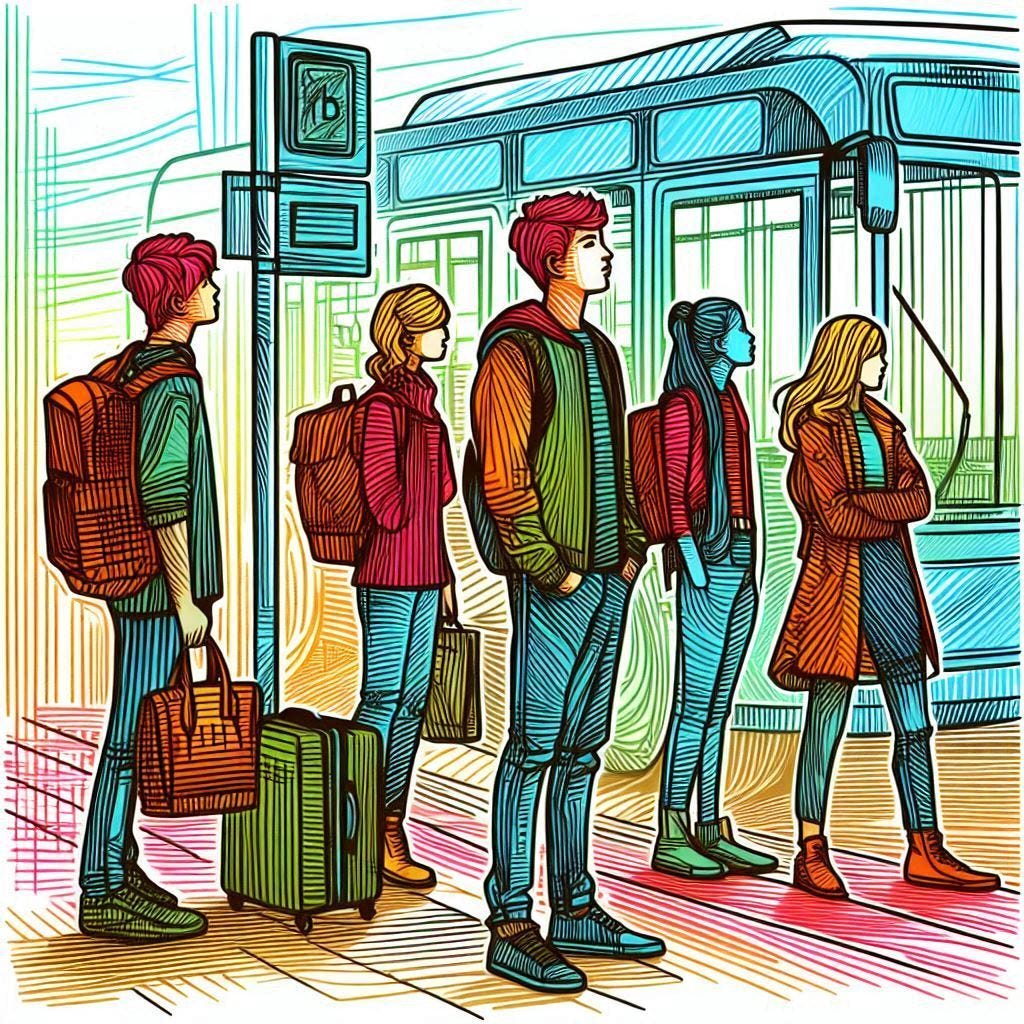
My next-door county, Kent, is one of the few places in the UK that still has grammar schools. There’s much research and heated debate about whether they’re a good system when it comes to results and socioeconomic diversity (they probably work pretty badly for those who don’t attend them, according to the data; they don’t even work remarkably well for those who do). What doesn’t often factor into these discussions, though, is commuting time – which is an inevitability when children from across a wide area are selected to attend a low number of schools.
Brazil is not Kent. But this Brazilian study on links between commuting and mental health is interesting partly because of the design – it tracked a relatively small number of students (213) over a period of time between Covid lockdowns and school re-openings – and partly because of the strength of the links it found.
The study’s researchers found that the odds of increased levels of depression were three times higher among students commuting to school by public transport. (I’m not wholly convinced by this – it seems at least feasible that back-to-school depression is more likely in students from poorer homes with lower resources, and the wealthiest students are unlikely to use public transport.) There’s probably some link with active commuting – good research supports the idea that movement is linked with better mental health, and teenagers who get buses or trains to school have less of a chance to walk or cycle there.
The researchers also found that those who had to commute for more than five kilometres were particularly likely to feel more depressed. This may be a particularly Brazilian feature: perhaps local public transport is uncommonly miserable. Or perhaps long commutes aren’t generally great for teenagers.
Takeaways: while this study probably isn’t that relevant to the UK, it does raise questions about commuting length. Full disclosure: I haven’t done a detailed literature search to see how well this has been covered in British research. But it might be something for parents to look into when thinking about school choice, and for policy makers and academy leaders to investigate when making decisions about admissions policies. (This may, too, be my own bias – I commuted to an Essex grammar school as a teenager for an hour and 45 minutes each way, using three or sometimes four modes of transport. That said, a smartphone and some downloaded sitcoms would have placed a very different veneer on my journey.)
That was a snapshot of some recent research: autonomy, ultra-processed food and school commutes – from East Asia to Brazil rather than Ibiza to the Norfolk Broads. Please comment below and let me know if there are specific areas of teenage mental health that would be interesting for future Substack editions, and please share this with anyone you think might be interested.